 English
 German

Case Study | Creating Transparency in Hospitals with RFID
INDUSTRY: Healthcare
Key Benefits
- An overview of inventory available at any time
- Fast deployment processes
- Greater planning certainty and improved capacity utilization
- transparent shipping routes
- significant, measurable time savings
KATHREIN PARTNER
Opal Solutions, LLC
KATHREIN PRODUCTS
- RRU 1400 Reader
- MidRange 100° PRO Antennas
- SMSH 60° EDGE Antennas
Would you like to receive further information, case studies or white papers in the future? Please register here to our newsletter.
EAn academic hospital in the Netherlands is using RFID technology from KATHREIN Solutions to reliably track medical equipment and transparently monitor its condition and operational readiness. Following its successful implementation in the endoscopy department, the solution was expanded to include the tracking of patient samples and transport containers.
Initial Situation
An academic hospital in the Netherlands faced the challenge of reliably tracking the location and operational status of medical equipment.
In the Endoscopy Department, managing the examination schedule was a time-consuming process.
In an effort to gain a better overview of the situation, the teaching hospital in the Netherlands approached a medical equipment company, which, together with OPAL Solutions GmbH, sought ways to use RFID (Radio Frequency Identification) to minimize the effort involved and thereby save time and money.
Solution and Implementation
“After extensive testing, the project team opted for RFID technology from KATHREIN Solutions. The deciding factors in choosing this manufacturer were the ease of integration into the infrastructure and the excellent reading results achieved in the test setups."
Jens Meyer, Project Manager, OPAL Solutions GmbH
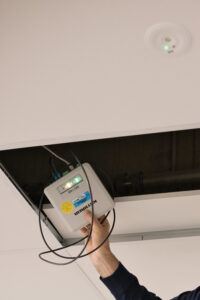
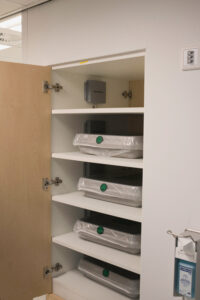
After the test setups proved successful both within the project team and at the hospital, the IT department in the Netherlands began discreetly installing antennas and readers at strategic locations—for example, near entrances and exits, inside cabinets, and near the elevators.
Reads from the RFID tags, processed by our own customized software, now reliably provide information on:
- Location of the Equipment
- Condition of the Equipment
- Operational Readiness
Expanding the Use of RFID in Everyday Hospital Operations
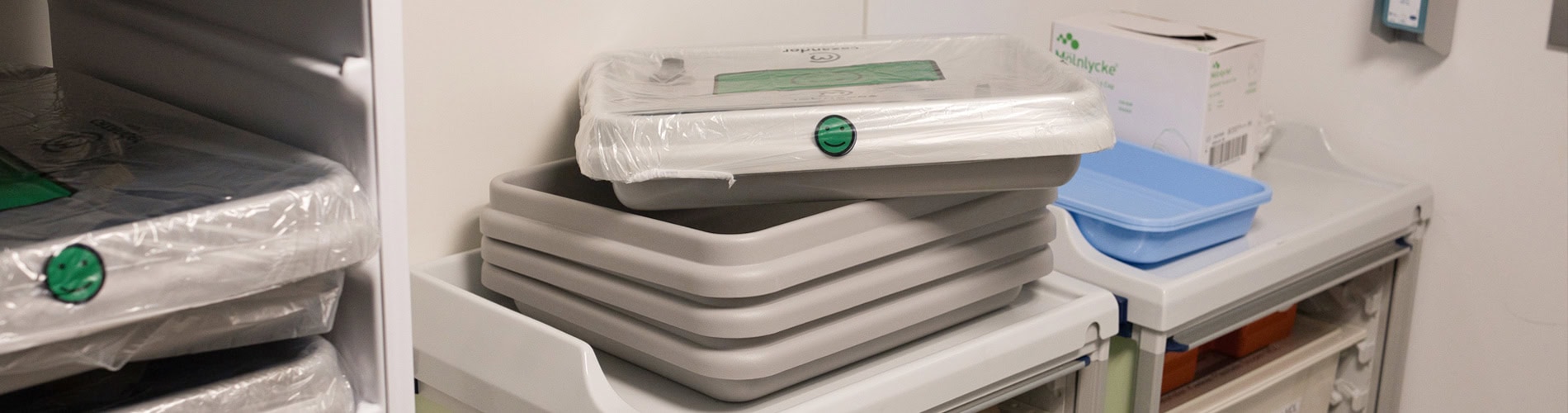
Following the successful integration of RFID into endoscopy, this system was adopted for use with patient specimens.
The samples are transported in transport boxes. The boxes and samples are „linked“ to each other in the software via an RFID chip—that is, digitally linked.
This means that employees can see the location of these samples at any time, regardless of which building the containers are in.
Results
With the introduction of RFID into everyday hospital operations, processes at the teaching hospital have been significantly improved. Employees benefit from:
- an overview of inventory that is available at any time
- faster deployment processes
- greater planning reliability and improved capacity utilization
- transparent shipping routes
- a clearly measurable time savings
Following discussions with all hospital staff involved, the response was consistently positive, and hospital operations improved.
What began as an idea quickly became, thanks to all the motivated and resourceful people involved, a first-of-its-kind initiative at the hospital, one that has had an entirely positive impact on day-to-day hospital operations.
Download as PDF