 English
  German
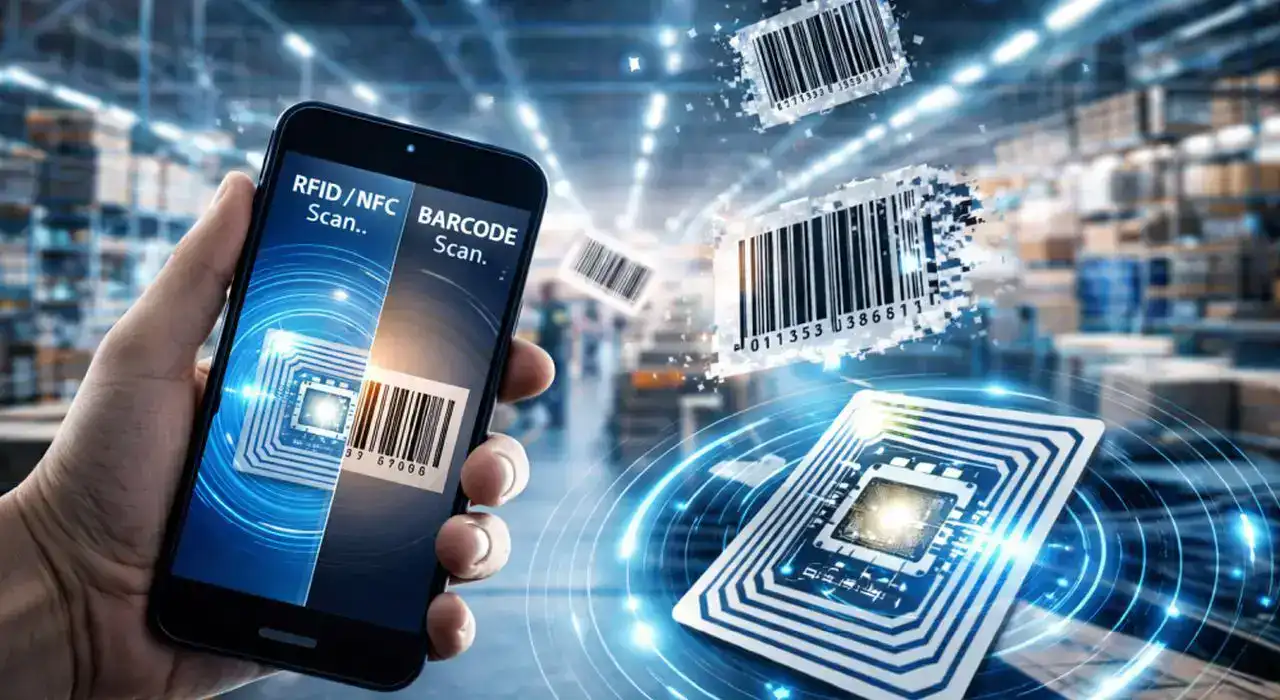
Barcodes were yesterday? How RFID is challenging the mass market
The Digital product passport (DPP) is a standardized data set that provides transparent information on materials, origin, use and recycling throughout the entire life cycle of a product, thus supporting the circular economy and sustainability goals. The DPP accelerates the spread of automated identification technologies, whereby UHF and HF RFID are complementary and barcodes are retained in price-sensitive cases. (Source cover image: Think WIoT)
Key messages from this interview:
- The Digital Product Passport promotes transparency, circular economy and resource efficiency and is not an end in itself.
- The DPP is open to all technologies; UHF RFID is particularly suitable for automated, high-volume processes.
- HF/NFC remains important for end customers; smartphones enable consumer reads, but not always logistical performance
- Barcodes and QR codes remain economically viable for very price-sensitive mass-produced items.
Does RFID have what it takes to replace the barcode in the mass market?
From the foothills of the Alps to the world: Thomas Brunner directs Kathrein Solutions, a globally renowned provider of antenna and Reader-innovations. For him, sustainability is not just a trend, but a key driver - and the Digital product passport an important step towards greater transparency and resource efficiency. In the Interview with Anja Van Bocxlaer from Think WIoT Brunner talks about opportunities, challenges and the key role of RFID technology for the Digital Product Passport.

Anja Van Bocxlaer, Managing Director, Think WIoT
1. brake or booster: Does the DPP make companies more sustainable - or just more bureaucracy?
Thomas Brunner, Managing Director, KATHREIN Solutions
I think the Digital Product Passport makes a lot of sense - especially with regard to the circular economy, resource efficiency, reuse and savings. It's about having reliable information at the end of a product's life cycle: What can you do with it? How can it be reused or recycled? What is it made of? In this day and age, I believe it is absolutely right that the European Union should create a regulatory basis for this.
I therefore don't see the DPP as a form of coercion or a high cost factor for the economy, but as a clearly positive thing. For me, the advantages clearly outweigh the disadvantages. I wouldn't overestimate it - on the contrary: I think many people underestimate the opportunities it offers. Of course, not all industries are set up like the German automotive industry, which has been working with a large supplier network according to VDA standards for decades and organizes its supply chain transparently - exactly what the DPP wants to achieve in other industries.
In the automotive industry, for example, there have been material databases for 20 years in which the exact percentage of what a component is made of must be entered. This allows a manufacturer to say at the touch of a button: „This vehicle with this equipment is made from these raw materials.“ In principle, we are now pursuing the same approach with the DPP.
Of course, a small company with 20 employees and little digital infrastructure may initially be overwhelmed by the requirements of the DPP. But this should not mean that we do not continue to develop and adapt structures and processes - just because there will always be companies that are not yet ready or willing to implement these changes.
Anja Van Bocxlaer, Managing Director, Think WIoT
2. will the digital product passport become a driver for RFID systems?

Thomas Brunner, Managing Director, KATHREIN Solutions
Yes, I think so. The DPP initiative is driven by regulatory requirements. If there are binding requirements, companies have to act. These requirements are strategically important for the European Union - which is precisely why they are being introduced.
Many companies have been working on technologies for automated recording and digital, transparent supply chains for years anyway. The goal has always been to further optimize these processes and make them more efficient - a goal that has existed since the early days of the „Auto-ID world“.
Investments in Europe are increasing year on year. We are seeing enormous momentum in the number of transponder chips being produced. More and more industries - from retail to the clothing industry and other sectors - are opting to equip every product with a digital transponder.
If a company such as Decathlon has already equipped all its products with RFID, it is easy to meet the DPP requirements using this medium. In this case, the investment for product tracking has already been made.
The DPP can accelerate this trend. Although not every DPP solution will automatically be an RFID solution, it will encourage many companies that have not yet thought about digitizing their supply chain to increase their efficiency. In turn, I believe this will have a very positive impact on our industry.
Anja Van Bocxlaer, Managing Director, Think WIoT
3 That sounds very positive at first, but how can the DPP work successfully?
Thomas Brunner, Managing Director, KATHREIN Solutions
Standardization is essential for this concept to work. Only with uniform standards can a circular value chain be reliably implemented. I expressly welcome the fact that the European Union is consistently pursuing this path - regardless of when exactly the next steps will be taken.
Anja Van Bocxlaer, Managing Director, Think WIoT
4. is it a mistake to limit the DPP to a single technology?
Thomas Brunner, Managing Director, KATHREIN Solutions
Yes, that would be a mistake. As far as technologies are concerned, the DPP is designed to be open to all technologies. For example, it can be used with a Barcode, a QR code or with HF or UHF RFID. The choice of technology naturally has an influence on which scanner or reader systems are required.
This technological openness is of central importance to me - because not every product that needs to be labeled and not every identification solution is suitable for an RFID label. And not every application benefits from optical codes.
In order to make progress as quickly as possible, it is crucial to proceed flexibly. The task of the regulatory authority is to create clear, practical standards and framework conditions that enable the use of common and proven identification technologies.
Anja Van Bocxlaer, Managing Director, Think WIoT
5 The DPP is open to all technologies - but the solutions are still competing. What advantages does UHF RFID offer for the DPP?
Thomas Brunner, Managing Director, KATHREIN Solutions
In my opinion, UHF technology is not yet sufficiently well known in many areas, both technologically and economically, and is sometimes underestimated - especially in terms of its potential for automation, transparency and increased efficiency.
In combination or in conjunction with the DPP, very good results can be achieved in supply chains and companies. This basically kills two birds with one stone. It therefore makes perfect sense to clearly position UHF as one of the possible technologies in the context of the DPP.
However, even as a manufacturer, I don't think it makes sense to specify UHF as the only technology for the DPP. That would be unrealistic anyway, because it would lead to high investments - especially for companies that do not have highly automated or work-sharing production or logistics.
Not every company in the European Union is set up in the same way. The DPP should therefore enable different, sensible and feasible solutions to meet the various requirements.
Anja Van Bocxlaer, Managing Director, Think WIoT
6. will HF technology lose market share as a result of the DPP?
Thomas Brunner, Managing Director, KATHREIN Solutions
No, I don't see that at all. HF technology is widely and even more established - it is widely used in smartphones, for example. There will therefore be many implementations of the DPP with NFC solutions. I clearly see them as complementary and don't think it's expedient to play technologies off against each other - even if some associations would like to.
A higher-level association such as the VDI or the VDMA would never come up with the idea of saying: „Please let us do everything with optics“ or „everything with HF“. There are simply different verticals and different levels of automation in the industries.
Perhaps the DPP will also be available for food at some point. Let's take an olive grower as an example: he probably needs a very simple solution with which he can digitally identify and authenticate his product. It is not necessary to read thousands of tags fully automatically at high speed.
This is completely different for manufacturers that produce in large quantities - such as kitchen appliances, household appliances or televisions. These have highly automated production lines with the corresponding potential for automated identification. Solutions that can be easily integrated into automated processes will be chosen here.
For example, if a manufacturer produces a pre-version that is already packaged in the warehouse and only defines the final version on delivery, this can be ideally implemented with dual technology. They can then give the device a final firmware or a final setup through the packaging and use this as part of the DPP - for example for regional usage restrictions or certificates. Such adjustments at the end can be implemented excellently with wireless technology - but not with a barcode that does not work through packaging.
Each of these technologies has its own advantages and the industry will want to use them accordingly. The task of the regulatory authority is to create a reasonable standard and framework so that common and established technologies can be used - while of course complying with security standards. QR code, NFC and also UHF meet these so that they guarantee the security required for the DPP.
The regulatory authority should enable broad use here. The industry can then work in a technology-neutral way and use the respective solution where it fits best in the sector.
Anja Van Bocxlaer, Managing Director, Think WIoT
7. will RFID replace the barcode in the mass market?
Thomas Brunner, Managing Director, KATHREIN Solutions
For very inexpensive products or products produced in large quantities (e.g. disposable packaging or consumer goods), the use of RFID will not be economically viable - here barcodes or QR codes remain the preferred choice. Even if the cost of RFID tags continues to fall, a simple paper label with a barcode remains cheaper in many cases. And especially when billions of items are produced, even the smallest price differences of a few cents make a considerable difference in the overall calculation.
The choice of technology - whether barcode, HF/NFC or UHF - will continue to depend heavily on the specific product, its application environment and the economic conditions. The DPP will not replace these decisions, but it will transform them into a standardized, interoperable system.
Anja Van Bocxlaer, Managing Director, Think WIoT
8. how relevant will the DPP be for end customers - and is the smartphone sufficient as a „reader“?
Thomas Brunner, Managing Director, KATHREIN Solutions
The DPP is not only aimed at logistical traceability, but also at enabling end users to actively retrieve information - via their smartphone, for example. NFC technology will therefore continue to play an important role in the future, as every consumer can read a product's digital passport using their own smartphone.
On the other hand, NFC or HF technology is less suitable for logistics processes. For this reason, every company will have to ask itself which identifier is the right one for the respective product and for the requirements of logistical automation. This means that the hybrid chip will become much more important in the future. The combination of UHF and HF technology makes it possible to achieve optimum performance in logistics and at the same time be read by the end consumer.
As long as there are no sufficiently powerful or widely available smartphones for consumers, RF technology will continue to play a very important role in the context of DPP.
Subscribe to the newsletter
Our newsletter keeps you up to date on new products, exciting use cases, case studies and upcoming events in the IoT world of Kathrein Solutions.